





Catalog

 .
.Other labels exist (Demeter, Biodyvin, Nature et Progrès...). These have more demanding specifications than organic farming but are not recognised by public agencies.
-
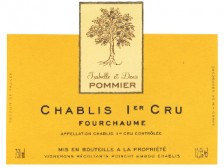
Isabelle and Denis Pommier started in 1990 with only 2 ha. They have made gradual progress, both in the constitution of their vineyards (now 16 ha) and in their cultivation practices (tillage, disbudding, certified organic from the 2014 vintage). Their wines, vinified and aged for a long time in oak barrels for Croix aux Moines and the 1st crus, have a richness and amplitude that contrast with the usual extreme vivacity of the Chablis.
According to the Bettane & Desseauve 2025 guide, “perhaps the most spectacular growth in the Chablis region over the last fifteen years”.
Quoted in the guide of the Revue du Vin de France.
The frosts of April 2021 were dramatic in Chablis: Domaine Pommier's 2021 harvest is barely a quarter of a normal harvest.
The 2021 vintage in the press:
Bourgogne Aujourd'hui (August 2024): 16.5/20 “Bright, golden color. Expressive aromas of yellow fruit and flowers, with discreet toasted-wood notes. Full-bodied, fat, taut, saline, “cut” to evolve well over time.”
Vinous (N. Martin - July 2023): 90/100 “The 2021 Chablis Fourchaume 1er Cru, whiwh spent six months on the fine lees, has a lovely peachy bouquet, defaying the leanness of the vintage. it bacomes quite minty with time. The palate is well-balanced with grapefruit and orange pith abd fine acidity, nicely, composed with a simple but quite tensile finish. This is a well-crafted Fourchaume.”
More- To keep or to drink:
- Ready to drink
- Apogée:
- 2026-2036
- Organic certification:
- 2014
- Alcohol degree:
- 13%
-
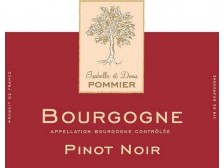
Isabelle and Denis Pommier started in 1990 with only 2 ha. They have made gradual progress, both in the constitution of their vineyards (now 16 ha) and in their cultivation practices (tillage, disbudding, certified organic from the 2014 vintage).
According to the Bettane & Desseauve 2025 guide, “perhaps the most spectacular growth in the Chablis region over the last fifteen years”.
Quoted in the guide of the Revue du Vin de France.
The 2022 vintage in the press:
La Revue du Vin de France (October 2024 ): 94/100 “Beautiful purity of northern Pinot, fresh and perfectly ripe. Scintillating fruit. A wine for medium ageing, remarkable for its harmony and relief”.
More- To keep or to drink:
- Ready to drink
- Apogée:
- 2025-2032
- Organic certification:
- 2014
- Alcohol degree:
- 14%
-
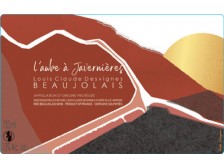
The philosophy of Domaine Desvignes is simple: respect tradition. Hence a culture without weedkillers, "old-fashioned" vinification and rather long maturations in cement vats only. The result is great structured morgons with a subtle and accomplished structure, and a keeping capacity worthy of the great Burgundies (10 years and more).
Rated three stars in the Revue du Vin de France guide.L'Aube à Javernières is a perfect entry-level Desvignes on a parcel of 0.84 ha on the edge of the Morgon appellation (Côte du Py), a frank Beaujolais, easy to drink but with a very present background.
The 2023 vintage in the press:
Bourgogne Aujourd'hui (November 2024): 16.5/20 “Vinified with 50% de-stemmed grapes, this cuvée reveals an intense color and a fine, fresh, fruity, spicy nose.... The wine is dense, greedy, coated and silky, with fine balance and finesse”.
Vinous (N. Martin - March 2025): 85-87/100 "The 2023 Beaujolais L'Aube à Javernières, which is close to Côte du Py, has an expressive red cherry-and-strawberry-scented bouquet that becomes more floral with aeration. The palate is medium-bodied with crunchy red fruit, quite strict and linear with straighforward peppery/sour cherry finish. Fine."
More- To keep or to drink:
- Ready to drink
- Apogée:
- 2025-2030
- Organic certification:
- 2023
- Alcohol degree:
- 13.5%
-
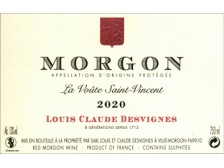
The philosophy of Domaine Desvignes is simple: respect tradition. Hence a culture without weedkillers, "old-fashioned" vinification and rather long maturations in cement vats only. The result is great structured morgons with a subtle and accomplished structure, and a keeping capacity worthy of the great Burgundies (10 years and more).
Rated three stars in the Revue du Vin de France guide.The estate's flagship, La Voûte Saint-Vincent is built on tender, greedy fruitiness, without lacking in substance.
The 2023 vintage in the press:
La Revue du Vin de France (2026 Guide): 93/100 "This appealing style reveals a distinctive burst of fruit and a certain panache."
More- To keep or to drink:
- Ready to drink
- Apogée:
- 2025-2030
- Organic certification:
- 2023
-
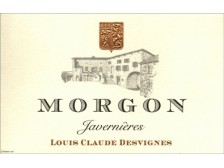
The philosophy of Domaine Desvignes is simple: respect tradition. Hence a culture without weedkillers, "old-fashioned" vinification and rather long maturations in cement vats only. The result is great structured morgons with a subtle and accomplished structure, and a keeping capacity worthy of the great Burgundies (10 years and more).
Rated three stars in the Revue du Vin de France guide.The estate's four greatest cuvées (Javernières, Côte du Py, Javernières Aux Pierres and the most famous, Les Impénitents) all come from the Côte du Py climat. These Morgons combine the richness of Gamay with exceptional depth and length. Fleshy wines, made for laying down.
The 2023 vintage in the press:
La Revue du Vin de France (2026 Guide): 96/100 "Javernières is still austere, tight and virile, but its coolness makes it delicious. In."
Vinous (N.Martin - April 2024): 90-92/100 “The 2023 Morgon Javernières has a deep and rounded nose, black cherries mixing with wild strawberries and oyster shells. The palate is medium-bodied with sapid, black-olive-tinged dark berry fruit, easing off toward the slightly confit-like finish. This is such a cemely Morgon that it will be nearly impossible to resist its youth.”
More- To keep or to drink:
- Wait 1 to 2 years
- Apogée:
- 2027-2035
- Organic certification:
- 2023
- Alcohol degree:
- 13.5%
-
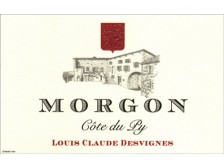
The philosophy of Domaine Desvignes is simple: respect tradition. Hence a culture without weedkillers, "old-fashioned" vinification and rather long maturations in cement vats only. The result is great structured morgons with a subtle and accomplished structure, and a keeping capacity worthy of the great Burgundies (10 years and more).
Rated three stars in the Revue du Vin de France guide.The estate's four greatest cuvées (Javernières, Côte du Py, Javernières Aux Pierres and the most famous, Les Impénitents) all come from the Côte du Py climat. These Morgons combine the richness of Gamay with exceptional depth and length. Fleshy wines, made for laying down.
The 2023 vintage in the press:
La Revue du Vin de France (2026 Guide): 94/100 "Côte du Py is dense for the locality, but it has good ageing potential."
Vinous (N. Martin - March 2025): 92/100 "The 2023 Morgon Côte du Py was bottled in July 2024. It has a lovely bouquet, very precise and complex with black fruit, truffle and light sea cave aromas. The palate is medium-bodied with grainy tannins, fine structure and backbone. The sustained finish is probably just beginning to close down for a while. Excellent."
Bourgogne Aujourd'hui (November 2024): 18/20 “Made from 80-year-old vines, with 95% of the grapes vinified whole and aged for 9 months in 30-hl concrete eggs (as for the Les Pierres cuvée), this top-flight Morgon has an intense color, a rich, precise nose of ripe black fruits and spices... Dense, compact, harmonious, long and racy on the palate, perfect for laying down."
"More- To keep or to drink:
- Wait 1 to 2 years
- Apogée:
- 2028-2038
- Organic certification:
- 2023
- Alcohol degree:
- 14.5%
-
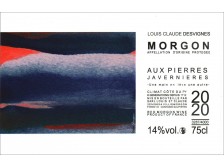
The philosophy of Domaine Desvignes is simple: respect tradition. Hence a culture without weedkillers, "old-fashioned" vinification and rather long maturations in cement vats only. The result is great structured morgons with a subtle and accomplished structure, and a keeping capacity worthy of the great Burgundies (10 years and more).
Rated three stars in the Revue du Vin de France guide.The estate's four greatest cuvées (Javernières, Côte du Py, Javernières Aux Pierres and the most famous, Les Impénitents) all come from the Côte du Py climat. These Morgons combine the richness of Gamay with exceptional depth and length. Fleshy wines, made for laying down.
The 2023 vintage in the press:
La Revue du Vin de France (2026 Guide): 93/100
Bourgogne Aujourd'hui (November 2024): 17.5/20 “Intense, brilliant purplish color. Aromas of black fruit, violets, spices...Rich, full, fleshy, juicy mouthfeel, with racy, velvety tannins, generous, greedy fruit and a fresh, elegant finish.”
Vinous (N.Martin - April 2024): 91-93/100 “The 2023 Morgon Aux Pierres Javernières comes from vines planted in 1931 and aged in concrete eggs. This is slightly more opulent and candied on the nose than the Côte du Py, perhaps without the same sophisitication. The palate is medium-bodied with fine-boned tannins, a little earthier in style, very well-balanced with an almost flinty finish. Excellent.”
More- To keep or to drink:
- Wait 1 to 2 years
- Apogée:
- 2028-2038
- Organic certification:
- 2023
- Alcohol degree:
- 14.5%
-
The philosophy of Domaine Desvignes is simple: respect tradition. Hence a culture without weedkillers, "old-fashioned" vinification and rather long maturations in cement vats only. The result is great structured morgons with a subtle and accomplished structure, and a keeping capacity worthy of the great Burgundies (10 years and more).
Rated three stars in the Revue du Vin de France guide.The estate's four greatest cuvées (Javernières, Côte du Py, Javernières Aux Pierres and the most famous, Les Impénitents) all come from the Côte du Py climat. These Morgons combine the richness of Gamay with exceptional depth and length. Fleshy wines, made for laying down.
The 2023 vintage in the press:
La Revue du Vin de France (2026 Guide): 96/100 "Les Impénitents is a delight: both flavourful and reserved, it is a truly great wine!"
Bourgogne Aujourd'hui (November 2024): 17.5/20 “In 2023, the domaine produced 3900 bottles of its now almost ‘cult’ cuvée des Impénitents from vines planted in 1920 below the hill of Py on clay and iron oxide soil. Intense color. Fine, fruity, floral, spicy, toasty nose.”
Vinous (N.Martin - April 2024): 92-94/100 “The 2023 Morgon Les Impénitents comes from the Domaine's oldest vines, planted in 1912 or 1914. Dark berry fruit, licorice and touches of graphite emerge on the nose. This is very complex and beautifully defined, one of thei more cerebral aromatic profiles in this vintage. The palate is medium-bodied with fine, slightly chalky tannins. Dark berry fruit mixes with black tea and black olive, leading to a structured and serious finish. try to resist temptation and allow it few years to settle this bottling repays patience.”
More- To keep or to drink:
- Wait 3 to 5 years
- Apogée:
- 2030-2042
- Organic certification:
- 2023
- Alcohol degree:
- 14%
-
Graeme, originally from New Zealand, and Julie cut their teeth at Domaine Ogier before setting up their own estate in 2015, with the aim of producing pure, precise and, above all, harmonious wines, both white and red. What a journey they have been on over the past decade, as the estate is now one of the most sought-after in the northern Rhône. It has been awarded two stars in the 2026 edition of the Revue du Vin de France guide (having earned its first star in the 2025 edition).
More- To keep or to drink:
- Ready to drink
- Apogée:
- 2026-2030
-
Graeme, originally from New Zealand, and Julie cut their teeth at Domaine Ogier before setting up their own estate in 2015, with the aim of producing pure, precise and, above all, harmonious wines, both white and red. What a journey they have been on over the past decade, as the estate is now one of the most sought-after in the northern Rhône. It has been awarded two stars in the 2026 edition of the Revue du Vin de France guide (having earned its first star in the 2025 edition).
The wines of Les Collines Rhodaniennes come from the Seyssuel terroir, opposite Côte-Rôtie on the left bank of the Rhône, with extremely stony soil – gneiss and mica schist – hence the name Kâmaka (meaning ‘rock’ in Māori).
The 2024 vintage in the press :
La Revue du Vin de France (Guide 2027) : 89/100 “Kamaka is a pure Viognier that emphasises freshness, with a light-bodied wine.”
More- To keep or to drink:
- Ready to drink
- Apogée:
- 2026-2032
- Grape varieties:
- 100% Viognier
-
Graeme, originally from New Zealand, and Julie cut their teeth at Domaine Ogier before setting up their own estate in 2015, with the aim of producing pure, precise and, above all, harmonious wines, both white and red. What a journey they have been on over the past decade, as the estate is now one of the most sought-after in the northern Rhône. It has been awarded two stars in the 2026 edition of the Revue du Vin de France guide (having earned its first star in the 2025 edition).
The 2024 vintage in the press :
La Revue du Vin de France (Guide 2027) : 92/100 "The Condrieu is full of vibrancy, with a focus on finesse."
Bettane + Desseauve (Guide 2027) : 92/100
More- To keep or to drink:
- Wait 1 to 2 years
- Apogée:
- 2027-2034
-
Graeme, originally from New Zealand, and Julie cut their teeth at Domaine Ogier before setting up their own estate in 2015, with the aim of producing pure, precise and, above all, harmonious wines, both white and red. What a journey they have been on over the past decade, as the estate is now one of the most sought-after in the northern Rhône. It has been awarded two stars in the 2026 edition of the Revue du Vin de France guide (having earned its first star in the 2025 edition).
L'Aleau was awarded 97/100 by the Revue du Vin de France: “A magnificent Condrieu, distinguished and flavourful, with splendid definition, devoid of any varietal character. It stands at the pinnacle of the appellation.”
The 2023 vintage in the press:
La Revue du Vin de France (2026 Guide): 97/100 “L'Aleau is a magnificent Condrieu, distinguished and flavourful, with splendid definition and not a trace of varietal character. It stands at the pinnacle of the appellation.”
Vinous (N. Greinacher – January 2026): 91/100 “The 2023 Condrieu L’Aleau shows well, opening with pristine apricot, quince, white peach, honeysuckle and yellow apple notes. Packed with more intensity and length relative to the entry-level Condrieu from the same vintage, the 2023 L’Aleau leaves the spotlight with persistence on the juicy finale.”
More- To keep or to drink:
- Wait 1 to 2 years
- Apogée:
- 2028-2038
- Grape varieties:
- 100% Viognier
-
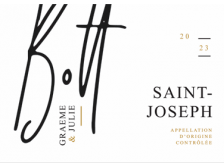
Graeme, originally from New Zealand, and Julie cut their teeth at Domaine Ogier before setting up their own estate in 2015, with the aim of producing pure, precise and, above all, harmonious wines, both white and red. What a journey they have been on over the past decade, as the estate is now one of the most sought-after in the northern Rhône. It has been awarded two stars in the 2026 edition of the Revue du Vin de France guide (having earned its first star in the 2025 edition).
The 2023 vintage in the press:
La Revue du Vin de France (2026 Guide): 94/100
Bettane + Desseauve (Guide 2027) : 93/100
More- To keep or to drink:
- Wait 1 to 2 years
- Apogée:
- 2027-2032
-
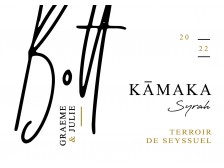
Graeme, originally from New Zealand, and Julie cut their teeth at Domaine Ogier before setting up their own estate in 2015, with the aim of producing pure, precise and, above all, harmonious wines, both white and red. What a journey they have been on over the past decade, as the estate is now one of the most sought-after in the northern Rhône. It has been awarded two stars in the 2026 edition of the Revue du Vin de France guide (having earned its first star in the 2025 edition).
The wines of Les Collines Rhodaniennes come from the Seyssuel terroir, opposite Côte-Rôtie on the left bank of the Rhône, with extremely stony soil – gneiss and mica schist – hence the name Kâmaka (meaning ‘rock’ in Māori).
More- To keep or to drink:
- Wait 3 to 5 years
- Apogée:
- 2030-2040
- Grape varieties:
- 100% Syrah
-
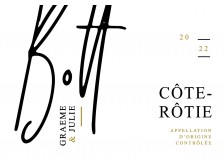
Graeme, originally from New Zealand, and Julie cut their teeth at Domaine Ogier before setting up their own estate in 2015, with the aim of producing pure, precise and, above all, harmonious wines, both white and red. What a journey they have been on over the past decade, as the estate is now one of the most sought-after in the northern Rhône. It has been awarded two stars in the 2026 edition of the Revue du Vin de France guide (having earned its first star in the 2025 edition).
More- To keep or to drink:
- Wait 3 to 5 years
- Apogée:
- 2030-2043
-
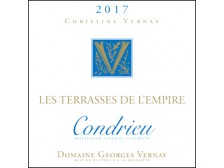
Georges Vernay was once known as the “Pope of Condrieu”, resurrecting this appellation from a mere 7 ha in 1960 to almost 200 ha today. Since 1997, his daughter Christine has continued his work step by step, converting the entire vineyard to biodynamic viticulture and creating new cuvées (Les Terrasses de l'Empire, Maison Rouge, Blonde du Seigneur...) for better parcel management.
Rated three stars in the Revue du Vin de France guide.
Les Terrasses de l'Empire is the archetypal Condrieu “on the fruit”, with inimitable aromas of white peach, apricot kernels and pruned almond. To be enjoyed young, for its pleasant freshness and finesse.The 2024 vintage in the press :
La Revue du Vin de France (Guide 2027) : 94/100 “Les Terrasses de l’Empire literally makes you forget the grape variety, as the terroir takes centre stage with a lovely salty note.”
Bettane + Desseauve (Guide 2027) : 91/100
More- To keep or to drink:
- Wait 1 to 2 years
- Apogée:
- 2027-2034
- Organic certification:
- 2020
- Grape varieties:
- 100% Viognier
-
Georges Vernay was once known as the “Pope of Condrieu”, resurrecting this appellation from a mere 7 ha in 1960 to almost 200 ha today. Since 1997, his daughter Christine has continued his work step by step, converting the entire vineyard to biodynamic viticulture and creating new cuvées (Les Terrasses de l'Empire, Maison Rouge, Blonde du Seigneur...) for better parcel management.
Rated three stars in the Revue du Vin de France guide.
Les Terrasses de l'Empire is the archetypal Condrieu “on the fruit”, with inimitable aromas of white peach, apricot kernels and pruned almond. To be enjoyed young, for its pleasant freshness and finesse.The 2023 vintage in the press:
La Revue du Vin de France (Guide 2026): 93/100 "Les Terrasses de l'Empire, for its generous fruitiness and immediate accessibility."
Bettane + Desseauve (Guide 2026) : 91/100
Vinous (N. Greinacher - November 2024): 92/100 "Fresh apricot, mango, spring blossom, banana and a touch os jasmine introduce the 2023 Condrieu Les Terrasses de L'Empire, a medium-bodied, hauntingly elegant Condrieu. Touching the palate with gentle concentration, the 2023 ends with a slice of juicy apricot on the sapid finish."
More- To keep or to drink:
- Ready to drink
- Apogée:
- 2025-2030
- Organic certification:
- 2020
- Alcohol degree:
- 14%
-
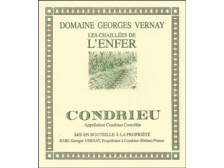
Georges Vernay was in his time known as the "Pope of Condrieu", resurrecting this appellation which counted only 7 ha in 1960 (nearly 200 ha today). Since 1997, his daughter Christine has continued his work step by step with the creation of new vintages (Les Terrasses de l'Empire, Maison Rouge, Blonde du Seigneur...) for a better parcel management and the conversion of the whole vineyard to biodynamic farming.
Rated three stars in the Revue du Vin de France guide.Les Chaillées de l'Enfer is a wine of tension and balance, with fruity notes (grapefruit, white peach) and herbal notes (mint, lemon thyme).
The 2024 vintage in the press :
La Revue du Vin de France (Guide 2027) : 96/100 Coup de ♥ "Les Chaillées de l’Enfer combine finesse and power, with rich, savoury fruit and lovely bitter notes."
Bettane + Desseauve (Guide 2027) : 94/100
More- To keep or to drink:
- Wait 1 to 2 years
- Apogée:
- 2027-2037
- Organic certification:
- 2020
- Grape varieties:
- 100% Viognier
-
Georges Vernay was in his time known as the "Pope of Condrieu", resurrecting this appellation which counted only 7 ha in 1960 (nearly 200 ha today). Since 1997, his daughter Christine has continued his work step by step with the creation of new vintages (Les Terrasses de l'Empire, Maison Rouge, Blonde du Seigneur...) for a better parcel management and the conversion of the whole vineyard to biodynamic farming.
Rated three stars in the Revue du Vin de France guide.Les Chaillées de l'Enfer is a wine of tension and balance, with fruity notes (grapefruit, white peach) and herbal notes (mint, lemon thyme).
The 2023 vintage in the press:
La Revue du Vin de France (Guide 2026): 96/100 "Les Chaillées de l'Enfer, with a sunny and complex profile, blending aromas of white and yellow fruits, flowers and citrus."
Bettane + Desseauve (Guide 2026) : 93/100
More- To keep or to drink:
- Ready to drink
- Apogée:
- 2026-2033
- Organic certification:
- 2020
- Alcohol degree:
- 14%
-
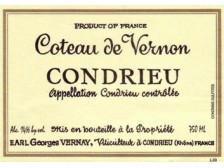
Georges Vernay was once known as the “Pope of Condrieu”, resurrecting this appellation from a mere 7 ha in 1960 to almost 200 ha today. Since 1997, his daughter Christine has continued his work step by step, converting the entire vineyard to biodynamic viticulture and creating new cuvées (Les Terrasses de l'Empire, Maison Rouge, Blonde du Seigneur...) for better parcel management.
Rated three stars in the Revue du Vin de France guide.Coteau de Vernon is the epicenter (and quintessence) of Condrieu: a wine of great aromatic complexity and extreme elegance.
The 2022 vintage in the press:
La Revue du Vin de France (Guide 2026): 97/100 "The phenomenal Coteau de Vernon, with remarkable balance and length."
Bettane + Desseauve (Guide 2026) : 97/100
More- To keep or to drink:
- Ready to drink
- Apogée:
- 2026-2038
- Organic certification:
- 2020
-
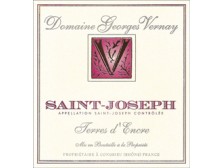
Georges Vernay was once known as the “Pope of Condrieu”, resurrecting this appellation from a mere 7 ha in 1960 to almost 200 ha today. Since 1997, his daughter Christine has continued his work step by step, converting the entire vineyard to biodynamic viticulture and creating new cuvées (Les Terrasses de l'Empire, Maison Rouge, Blonde du Seigneur...) for better parcel management.
Rated three stars in the Revue du Vin de France guide.More- To keep or to drink:
- Ready to drink
- Apogée:
- 2025-2033
- Organic certification:
- 2020
- Alcohol degree:
- 13%
-
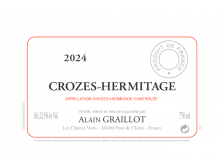
Regarded as the ‘pope of Crozes-Hermitage’, the Alain Graillot estate has, since the 1980s, played a major role in raising the profile of this appellation, which was previously so undervalued. On alluvial gravel soils (at the confluence of the Isère and Rhône rivers), this estate has been producing straightforward, juicy, elegant and, above all, perfectly easy-drinking wines for 40 years. Awarded two stars in the 2026 edition of the Revue du Vin de France guide.
The 2024 vintage in the press:
La Revue du Vin de France (Guide 2027) : 93/100 “The white Crozes takes us on a flavourful journey: creamy, enveloping fruit, with depth and structure.”
Vinous (N. Greinacher – January 2026): 89/100 “The light to medium-bodied 2024 Crozes-Hermitage Blanc starts its aromatic profile with flinty lemon flesh, ripe pear and white peach. Crisp and bright, the 2024 packs moderate overall substance and concludes with a clean finish.”
More- To keep or to drink:
- Wait 1 to 2 years
- Apogée:
- 2027-2034
- Grape varieties:
- 80% marsanne, 20% roussanne
-
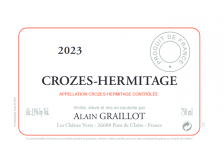
Regarded as the ‘pope of Crozes-Hermitage’, the Alain Graillot estate has, since the 1980s, played a major role in raising the profile of this appellation, which was previously so undervalued. On alluvial gravel soils (at the confluence of the Isère and Rhône rivers), this estate has been producing straightforward, juicy, elegant and, above all, perfectly easy-drinking wines for 40 years. Awarded two stars in the 2026 edition of the Revue du Vin de France guide.
The 2023 vintage in the press:
La Revue du Vin de France (2026 Guide): 92/100 “The reds are up to the task: in the typically ‘unpretentious’ style we’ve come to expect, the Crozes delivers a spicy and juicy performance, carried by the whole-cluster harvest which lends it a noble vegetal character. It’s hard to resist.”
Vinous (N. Greinacher – January 2026): 91/100 “The 2023 Crozes-Hermitage comes out shining, opening with dried violets, orange rind and ripe red fruits. Delicately assertive fleshy tones add more complexity. Midweighted and refined, the 2023 surpasses the 2022 by a landslide, doubling down with accentuated freshness on the savoury finale.”
More- To keep or to drink:
- Wait 1 to 2 years
- Apogée:
- 2027-2035
-
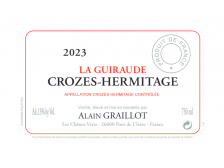
Regarded as the ‘pope of Crozes-Hermitage’, the Alain Graillot estate has, since the 1980s, played a major role in raising the profile of this appellation, which was previously so undervalued. On alluvial gravel soils (at the confluence of the Isère and Rhône rivers), this estate has been producing straightforward, juicy, elegant and, above all, perfectly easy-drinking wines for 40 years. Awarded two stars in the 2026 edition of the Revue du Vin de France guide.
La Guiraude is not a single-vineyard cuvée but a selection of the finest barrels from a great vintage. In 2023, it was a "coup de cœur" in the Revue du Vin de France, scoring 94/100: "Admirable, with depth, length and a wonderfully juicy expression".
The 2023 vintage in the press:
La Revue du Vin de France (2026 Guide): 94/100 Coup de ♥ “La Guiraude, a selection of barrels, is admirable, with depth, length and a wonderfully juicy character.”
Vinous (N. Greinacher – January 2026): 93/100 “The 2023 Crozes-Hermitage La Guiraude shows well, opening with pronounced spice box, dried violets, forest strawberry and ripe black cherry. Medium-bodied and concentrated, the 2023 shows outstanding overall balance, bringing the palate to rest with well-etched tension and gentle tannic structure.”
More- To keep or to drink:
- Wait 1 to 2 years
- Apogée:
- 2028-2040
-
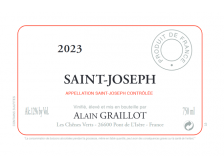
Regarded as the ‘pope of Crozes-Hermitage’, the Alain Graillot estate has, since the 1980s, played a major role in raising the profile of this appellation, which was previously so undervalued. On alluvial gravel soils (at the confluence of the Isère and Rhône rivers), this estate has been producing straightforward, juicy, elegant and, above all, perfectly easy-drinking wines for 40 years. Awarded two stars in the 2026 edition of the Revue du Vin de France guide.
The 2023 vintage in the press:
La Revue du Vin de France (2026 Guide): 93/100
Vinous (N. Greinacher – January 2026): 90/100 “The 2023 Saint-Joseph comes forward nicely in these early days, opening with delicate licorice, black cherry, clove and hints of blackberry. Round and refined, the medium-bodied 2023 checks out with spicy persistence.”
More- To keep or to drink:
- Wait 1 to 2 years
- Apogée:
- 2028-2037
-
Taking over 10 hectares of vines from the family estate to set up his own winery, Mickaël Salmon launched his venture in 2019 with a clear vision: conversion to organic farming, ageing on lees in suitable vessels (glazed cement vats, ceramic jars, clay eggs, oak demi-muids, etc.), no stirring to preserve the wines’ full freshness, and bottling without filtration and under inert gas. From his very first vintages, Lucas Salmon has been among the rising stars of Muscadet, an appellation undergoing a revival. One to watch.
Terroirs comes from two plots of young vines (7 and 10 years old), Les Brosses from the old vines (25 to 75 years old) of the vineyard, and Les Enfermures, a selection from a plot planted in 1950. These wines are crisp and lively, with citrus notes and a vibrant minerality. What’s more, the value for money of these three wines is outstanding!
The 2024 vintage in the press :
La Revue du Vin de France (July–August 2026) : 91/100 “This perfectly crafted white wine beautifully captures the essence of the terroir. It has substance and a subtly bitter, upright character.”
More- To keep or to drink:
- Ready to drink
- Apogée:
- 2026-2030
- Alcohol degree:
- 12%
- Grape varieties:
- 100% Melon de Bourgogne
-
Within the Anjou wine region, Savennières is a 150-hectare municipal appellation dedicated to white wines (100% Chenin), comprising, as in Burgundy, two contiguous sub-appellations: Roche aux Moines (22 hectares) and Coulée de Serrant (7 hectares). At the heart of the Roche aux Moines appellation, the iconic Aux Moines estate (12 hectares) shines brightly with superb dry white wines that perfectly combine body and crystalline purity, refinement and mineral energy. Bravo! Logically awarded two stars in the 2026 edition of the Revue du Vin de France guide.
The Aux Moines estate produces only two wines. Le Berceau des Fées comes from the estate’s young vines (2 ha), vinified and aged in stainless steel vats, bottled unfiltered and without sulphur. La Roche aux Moines is their flagship wine (10 ha), aged for 12 months in barrels and casks. Refined and with dazzling mineral energy, it is one of the greatest wines the Loire has to offer!
The 2025 vintage in the press :
La Revue du Vin de France (Guide 2027) : 89/100 “A lively, full-bodied wine from Le Berceau des Fées, perfect for enjoying now as an aperitif.”
More- To keep or to drink:
- Ready to drink
- Apogée:
- 2026-2030
- Organic certification:
- 2017
- Grape varieties:
- 100% Chenin
-
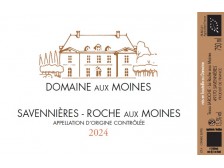
Within the Anjou wine region, Savennières is a 150-hectare municipal appellation dedicated to white wines (100% Chenin), comprising, as in Burgundy, two contiguous sub-appellations: Roche aux Moines (22 hectares) and Coulée de Serrant (7 hectares). At the heart of the Roche aux Moines appellation, the iconic Aux Moines estate (12 hectares) shines brightly with superb dry white wines that perfectly combine body and crystalline purity, refinement and mineral energy. Bravo! Logically awarded two stars in the 2026 edition of the Revue du Vin de France guide.
The Aux Moines estate produces only two wines. Le Berceau des Fées comes from the estate’s young vines (2 ha), vinified and aged in stainless steel vats, bottled unfiltered and without sulphur. La Roche aux Moines is their flagship wine (10 ha), aged for 12 months in barrels and casks. Refined and with dazzling mineral energy, it is one of the greatest wines the Loire has to offer!
The 2024 vintage in the presse :
La Revue du Vin de France (Guide 2027) : 93/100
More- To keep or to drink:
- Wait 1 to 2 years
- Apogée:
- 2028-2038
- Organic certification:
- 2017
- Grape varieties:
- 100% Chenin
-
It is François Chidaine who, since 1989, has sounded the awakening of Touraine wines and given the white Chenin its letters of nobility. Biodynamic since 1999, his wines show a crystalline purity and a vibrancy that are a reference... with prices that are just as exemplary.
Rated three stars in the Revue du Vin de France guide.
The Vouvray wines of Domaine Chidaine (Les Argiles, Baudoin) are hidden under the appellation Vin de France. They can no longer claim the Vouvray appellation since 2011 because they are vinified at the estate in Montlouis-sur-Loire (i.e. on the other side of the bridge over the Loire) and not in the commune of Vouvray. The INAO has reasons that reason does not know!More- To keep or to drink:
- Ready to drink
- Apogée:
- 2025-2032
- Organic certification:
- 1992
-
It is François Chidaine who, since 1989, has sounded the awakening of Touraine wines and given the white Chenin its letters of nobility. Biodynamic since 1999, his wines show a crystalline purity and a vibrancy that are a reference... with prices that are just as exemplary.
Rated three stars in the Revue du Vin de France guide.
The Vouvray wines of Domaine Chidaine (Les Argiles, Baudoin) are hidden under the appellation Vin de France. They can no longer claim the Vouvray appellation since 2011 because they are vinified at the estate in Montlouis-sur-Loire (i.e. on the other side of the bridge over the Loire) and not in the commune of Vouvray. The INAO has reasons that reason does not know!The 2024 vintage in the press :
La Revue du Vin de France (Guide 2027) : 92/100 “What panache! Baudoin flows as clear as crystal, fluid and full of energy.”
More- To keep or to drink:
- Wait 1 to 2 years
- Apogée:
- 2027-2037
- Organic certification:
- 1992
- Alcohol degree:
- 12.5%